📌 What Is EEC–2025?
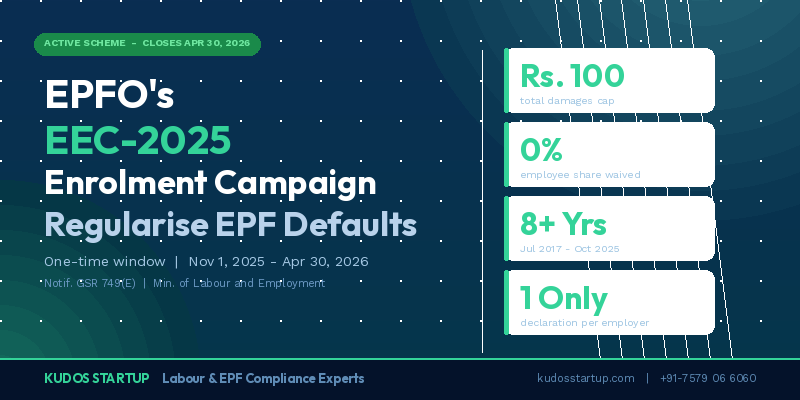
The Employees' Enrolment Campaign, 2025 (EEC–2025) is a special one-time compliance window notified by the Ministry of Labour & Employment, Government of India, vide G.S.R. 749(E) dated 10th October 2025, under Section 5 read with sub-section (1) of Section 7 of the Employees' Provident Funds and Miscellaneous Provisions Act, 1952.
Simply put — if your company missed enrolling some employees in the EPF scheme between 1st July 2017 and 31st October 2025, this is your chance to come clean, regularise those employees, and avoid heavy penalties. All at a remarkably low cost.
⏰
Deadline Alert: The EEC–2025 window runs from 1st November 2025 to 30th April 2026. Declarations filed after 30th April 2026 will NOT be entertained under this scheme. Act before the window closes.
🎯 Why Did EPFO Launch This Scheme?
Many employers — especially small businesses, MSMEs, and startups — failed to enrol all eligible employees in EPF due to lack of awareness, cash flow constraints, or administrative oversights. Under normal circumstances, such defaults attract heavy damages: up to 25% per annum under Section 14B of the EPF Act, plus interest at 12% per annum under Section 7Q.
For a company that defaulted for 5–6 years, this can run into lakhs of rupees — making voluntary disclosure financially unviable. EEC–2025 breaks this deadlock by capping all damages at a flat ₹100 per establishment, regardless of the number of employees or the period of default.
💰 Financial Benefits at a Glance
🙅
Employee's Share — Waived
If the employee's EPF contribution was never deducted, the employer does not need to pay it now.
✓ Fully Waived💼
Employer's Share — Must Pay
Employer's contribution + 7Q interest + administrative charges must be deposited in full for the declared period.
Must be paid⚖️
Damages — Capped at ₹100
Damages across all three schemes — EPF, EPS, and EDLI — are capped at just ₹100 per establishment in total.
Flat ₹100 only
✅ Who Is Eligible to Participate?
The scheme is open to all establishments — whether currently covered under the EPF & MP Act or not yet registered. This includes:
- Private limited companies, LLPs, partnerships, and proprietorships with 20+ employees
- Establishments voluntarily covered under the EPF Act
- Establishments facing inquiries under Section 7A of the EPF Act, Paragraph 26B of the EPF Scheme 1952, or Paragraph 8 of the EPS 1995
- New establishments registering under EPFO for the first time
ℹ️
Note for establishments under inquiry: You can still participate, but the benefit of the scheme (i.e., ₹100 damages) will apply only to the period covered under the inquiry. Normal damages will apply to any other period.
👥 Which Employees Can Be Declared?
Not all past employees are covered. An employee is eligible for declaration only if all three conditions are met:
- They joined employment between 1st July 2017 and 31st October 2025
- They were eligible for EPF membership but were not enrolled at the time
- They are alive and still employed with the establishment on the date of declaration
🚫
Important Exclusion: Employees who have already exited (resigned, retired, or otherwise left) before the declaration date cannot be enrolled under EEC–2025. However, if all existing employees are duly declared and no deducted contributions remain unpaid, no suo motu action will be taken for past exitees.
🌍
International Workers Not Eligible: The incentives and benefits under EEC–2025 are available for enrolment of Indian nationals only. International workers are excluded from this campaign.
📋 Step-by-Step: How to File a Declaration
- Log in to the EPFO Employer Portal (unified.epfo.gov.in) and access the EEC–2025 module.
- Generate a Face Authentication–based UAN for each eligible employee to be declared, using the UMANG App.
- Prepare the list of employees to be declared — verify their date of joining, wages, and EPF eligibility.
- File the online declaration through the EPFO portal. Remember: only one declaration per employer is permitted.
- A Temporary Return Reference Number (TRRN) will be generated — use this to prepare the Electronic Challan-cum-Return (ECR).
- Remit the employer's EPF contribution, interest, and administrative charges via the ECR linked to the TRRN.
- Pay the flat ₹100 damages amount to complete the process.
⚠️
One Declaration Only: An employer can file only one declaration under EEC–2025. Make sure all eligible employees are included before submitting. You will not get a second chance under this scheme.
🔗 Linkage with PM–VBRY Scheme
Employers who declare employees or register afresh under EEC–2025 may also become eligible for benefits under the Pradhan Mantri Vishwakarma Bharat Rojgar Yojana (PM–VBRY), subject to the terms and conditions of that scheme. This provides an additional incentive for new registrations and fresh enrolments under EEC–2025.
⚠️ Consequences of False Declarations
The scheme is designed to encourage genuine compliance — not to be misused. Any declaration made through misrepresentation or suppression of facts shall be treated as void ab initio (as if it never existed) and will attract penal action under the EPF & MP Act, 1952 and the relevant schemes. The savings from this scheme are not worth the risk of a fraudulent filing.
📅 Key Dates
📆
1 Jul 2017 – 31 Oct 2025
The eligible period — employees who joined and were missed for EPF during this window can be declared.
📢
10 October 2025
G.S.R. 749(E) issued. EEC–2025 officially notified by Ministry of Labour & Employment.
✅
1 November 2025 — Scheme Opens
Filing window begins. Employers can start submitting declarations on the EPFO portal.
🔒
30 April 2026 — Last Date
Scheme closes. Declarations filed after this date will not be considered. No extensions expected.
🏢 How Kudos Startup Can Help You
Navigating EPFO compliance — especially a time-bound amnesty scheme like EEC–2025 — requires careful identification of eligible employees, accurate calculation of contributions and interest, and flawless portal filing. A single error can mean the difference between ₹100 in damages and lakhs in penalties.
At Kudos Startup, our team of Chartered Accountants, Company Secretaries, and Labour Law Compliance Experts based in Dehradun can handle the entire EEC–2025 process for your business — from employee eligibility audit to TRRN generation, ECR preparation, and final submission. We serve businesses across Uttarakhand and all of India.
🚀
Don't wait until April! The earlier you file, the more time you have to identify all eligible employees accurately. Call us today for a free EPF compliance review for your business.
❓ Frequently Asked Questions
Can we file for employees who left before the declaration date?
No. Only employees who are alive and currently employed with the establishment on the date of declaration are eligible under EEC–2025. Exited employees cannot be enrolled under this scheme. However, if all current eligible employees are declared and no deducted dues remain unpaid, EPFO will not initiate action for past ex-employees.
What if we missed enrolling some employees before July 2017?
EEC–2025 covers only the period from 1st July 2017 to 31st October 2025. Employees missed before July 2017 are not covered under this scheme and will need to be addressed through regular EPFO compliance procedures.
Are the damages really just ₹100? Isn't that too good to be true?
Yes — damages across all three schemes (EPF, EPS, and EDLI) are capped at ₹100 per establishment under EEC–2025. This is the official government notification. However, the employer must still pay the full employer's share of EPF contributions for the declared period plus applicable interest under Section 7Q.
We are a startup that was never registered under EPFO. Can we use EEC–2025?
Yes. Establishments not yet covered under the EPF & MP Act are also eligible to participate in EEC–2025. You can register with EPFO and simultaneously enroll employees in the scheme.
Can we file more than one declaration for different sets of employees?
No. Only one declaration per employer is permitted under EEC–2025. It is therefore critical to ensure all eligible employees are included in the single declaration before filing.